Whether streaming or downloading, choosing the right MP3 audio bitrate involves more than just picking the highest number available. Audio bitrate determines both the sound quality and file size of your music, but practical listening scenarios also play a major role in selecting what suits you best. Mp3Juice offers MP3 files in a range of common bitrates, depending on the source and conversion settings. Understanding these differences will help you balance sound quality, device storage, and internet use for an optimal listening experience.
What Is Audio Bitrate and Why Does It Matter?
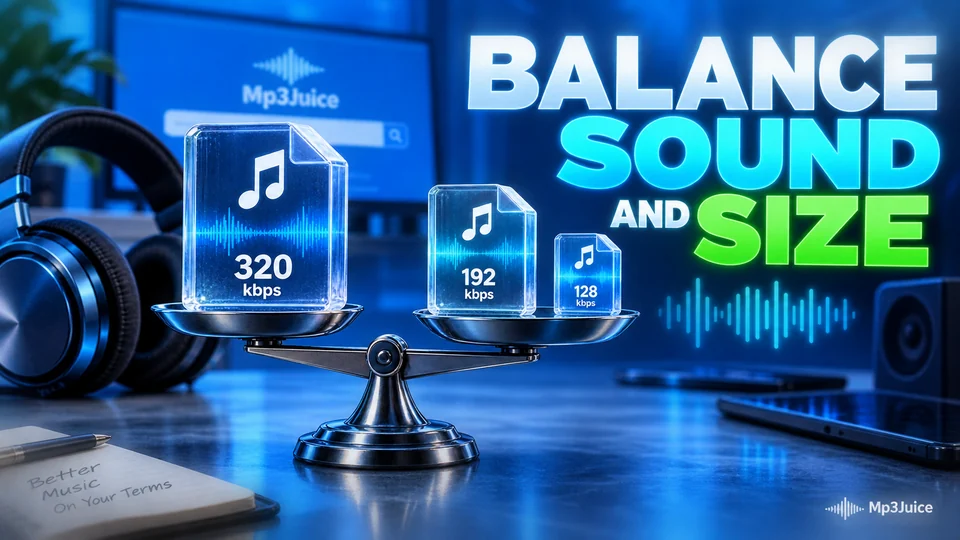
Bitrate in MP3 files measures how much audio data is stored per second, typically in kilobits per second (kbps). The higher the bitrate, the more detail is preserved from the original recording, but the file size grows as well. For music downloads, bitrates commonly found are 128, 192, 256, and 320 kbps, though not all rates are offered for every track or service. Generally:
- Higher bitrate = better sound quality, larger file size.
- Lower bitrate = smaller file size, but less audio detail.
It's important to remember that MP3 is a "lossy" format, some audio information is always removed to keep files small, regardless of the chosen bitrate.
Comparing Common MP3 Bitrates and Storage Needs
Understanding how bitrates affect daily listening and storage is best served through a direct comparison. The table below estimates file sizes for a typical 4-minute song:
| Bitrate (kbps) | Relative Audio Quality | Approx. 4-Minute Song Size | Fit on 1 GB Storage* | Typical Use Case |
|---|---|---|---|---|
| 128 | Acceptable for casual or spoken audio | ~3.8 MB | ~260 songs | Podcasts, background listening |
| 192 | Good compromise for most music | ~5.7 MB | ~175 songs | Standard portable music |
| 256 | Very good, subtle improvement over 192 | ~7.6 MB | ~130 songs | Better speakers/headphones |
| 320 | Near best for MP3, high detail | ~9.8 MB | ~100 songs | Hi-fi systems, keen listeners |
*Estimates based on constant bitrate MP3s; individual results vary by song length and encoding.
How Does Bitrate Affect Your Listening Experience?
The difference between bitrates is most noticeable in the fine texture of music, especially in complex or dynamic passages, high-frequency sounds (like cymbals), and the clarity of vocals. Some key scenarios:
- 128 kbps: Efficient for voice or talk radio, somewhat muffled for full music. Suited for older devices, limited bandwidth situations, or when quantity matters more than precise fidelity.
- 192 kbps: Provides clear, full sound suitable for general music listening through smartphones or car audio. The detail loss may be detectable on loud, high-quality equipment.
- 256 kbps: Improves on 192 kbps, offering better separation and sharper highs, especially with good headphones. Often chosen by people who want better sound but without large files.
- 320 kbps: As close as MP3 format allows to the original digital recording, though not identical. Useful for critical listening or archiving, if storage and download speed are not concerns.
Practical everyday listening, for example, music on wireless earbuds during a commute, rarely exposes the drawbacks of 192 or 256 kbps MP3s. Differences become more significant through home audio systems or in silent, critical listening tests.
When to Choose Each Bitrate on Mp3Juice
Mp3Juice does not universally guarantee any single bitrate for every track. Available options depend on the song source and how it was originally encoded. When you have a choice or need to decide what best fits your situation:
- Opt for 128 kbps if you want to maximize storage or download quickly for voice-heavy content.
- Pick 192 kbps for everyday listening, if you mainly use phones, small speakers or car stereos.
- Try 256 kbps for diverse music formats, clearer sound on decent headphones, and when you prefer a balance.
- Use 320 kbps for critical listening environments, large speakers, or storing favorites in the best available quality.
For a guide to the broader music search and downloads process, see the Mp3Juice Music Search and Download Guide.
Storage and Bandwidth Tips for Mobile Users
Choosing higher bitrates means larger downloads and more space required on your phone or SD card. If you regularly download lots of songs through Mp3Juice, keep your available storage in mind and consider how much data your network supports. Downloading lower bitrate files may help conserve storage on basic devices or help avoid mobile data overages. Refer to How to Use Mp3Juice on Mobile Devices for mobile tips.
Lossy Format Limitations: CBR and VBR in MP3s
MP3 files may use either Constant Bit Rate (CBR) or Variable Bit Rate (VBR) encoding. CBR keeps the data rate fixed throughout the track, making file size and estimate calculations simple. VBR adjusts bitrate for complex or simple parts, improving average quality for the same file size. However, Mp3Juice conversions from video often use CBR by default, especially for predictable playback. For a detailed breakdown, see CBR vs VBR MP3.
Quick Checklist: How to Choose Your MP3 Bitrate
- Check device storage, file size, and data limits before downloading.
- Think about your playback gear, basic earbuds or premium speakers?
- Consider music style; electronic and acoustic genres reveal compression more than spoken word.
- Favor higher bitrates for important or frequently played tracks.
- When in doubt, try 192 or 256 kbps for best balance.
If you want more information about MP3 technology itself, MP3 Audio Explained explores how these files are created and what distinguishes various qualities.
Frequently Asked Questions
Does Mp3Juice always offer 320 kbps downloads for every song?
No. Mp3Juice provides the highest available bitrate offered by the source for each song. While 320 kbps is popular, not all tracks can be converted at this rate, as it depends on both the origin's quality and conversion options.
Can I improve the sound quality of a low bitrate MP3 if I re-encode it?
No. Increasing the bitrate of an already compressed MP3 cannot restore lost audio detail. The best quality is always determined by the original source file and its initial encoding.
How do I pick the right bitrate for my device?
If you use small speakers or wireless earbuds, 192 kbps is usually sufficient. For high-end headphones or audio systems, 256 or 320 kbps offers an improved listening experience as long as storage and data use are not an issue.
For a wider perspective on how audio bitrates compare to other technical audio terms, read Bitrate vs Sample Rate.
If you want to begin searching for music now, visit the Mp3Juice homepage to try the search tool directly.